The Relationship between Stress and Academics
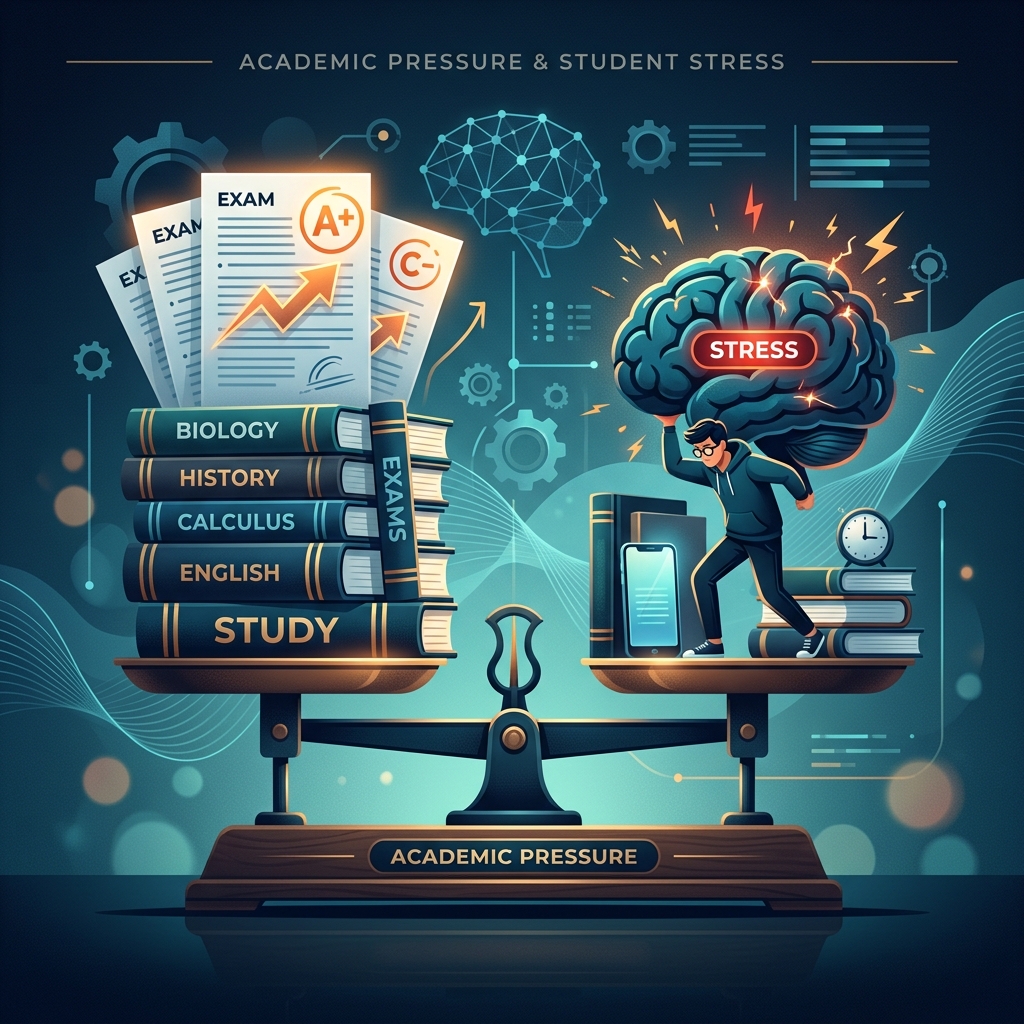
Many teenagers today are stressed about their academic performance in high school. The desire to get straight As results in grades being a major stressor among students. This pressure to obtain a high GPA originates not only from the students themselves but also from their peers, parents, and siblings. The pressure on students to achieve academic excellence is only increasing in today’s society, which may be due in part to the trend of declining acceptance rates across colleges. As a result, many students and parents think that a 4.0 GPA is a prerequisite to getting into a good college. Despite this belief being debatable, pressure for academic achievement causes stress to many students, which can have major effects on their mental health.
To examine the link between stress, depression, and academic performance, Yuwei Deng et. al. (2022) conducted a study by administering a questionnaire to undergraduate and postgraduate students. They found that extended academic stress positively impacts students’ depression levels. Yet, a study conducted by Wang et. al. (2023) observed that a higher level of academic stress is associated with a higher level of school burnout, which can lead to a higher degree of depression. Students get tired and are less motivated when they are constantly stressed about assignments and school work. When students experience burnout, this can be detrimental to their mental health and may result in depression. A study conducted by Satinsky et al. (2021) also found similar results when they observed that Ph.D. students commonly indicated depression and anxiety. A lot of work is required to earn a Ph.D. and the workload can lead to stress among Ph.D. students. Ph.D. students are gaining knowledge so they are well versed in their field of study, so it is important that their mental health is poor. This way they are in the best space so they can use their knowledge to best benefit society. Another study that saw similar findings was a study by Deb et al. (2021) that found that depression, anxiety, behavioral difficulties, irritability, among other issues, are often observed in students who experience a lot of academic stress. Academic stress is associated with many difficulties in people’s mental health, which prevents them from living their best life.
Moreover, depression resulting from academic pressure can result in instances of self-harm. A study conducted by Xuchen Guo et al. (2026) aimed to determine if there was an association between academic pressure and adolescent depressive symptoms and self-harm. Through their research, they found strong evidence that adolescents who reported higher levels of academic pressure when they were 15 years old had an increased number of depressive symptoms when they were between 16 and 22 years old. This demonstrates how stress can have long term effects on an individual. Experiencing high levels of stress and pressure due to school, can affect your mental health even almost 10 years later. They also discovered that higher academic pressure when participants were 15 years old was associated with instances of self-harm later in their lives, between the ages of 16 and 24 years old. Self-harm is a very serious issue. The stress that is caused by academic performance may lead to self-hatred. People may feel like they deserve to be punished by hurting themselves or gradually hate oneself because of the constant pressure to get an A. Further research should be done on what causes people to feel the desire to harm themselves after experiencing academic stress.
Research has shown that there is a defined link between academic pressure and depression. With societal expectations increasingly pressuring teenagers to be high achievers and painting the college admissions cycle as an all-or-nothing process, it is not a surprise that depression rates in adolescents have skyrocketed in recent years. While it may not seem like it, grades are not a holistic representation of a person. That’s not to say students shouldn’t strive to get good grades in school, but rather, they shouldn’t let the pressure of academic achievement cause them immense stress. For individuals who feel overwhelmed by school work and the pressure to succeed, there are strategies to cope. Mindfulness techniques can also help individuals focus on the present and help acknowledge and push aside feelings of self-doubt and worry. Furthermore, practicing positive self-talk and learning to be less judgmental of yourself can help ease anxiety and improve self-esteem. These strategies are easier said than done, so it is important to reach out to a trusted adult or professional if you are experiencing depressive symptoms and ideas of self-harm caused by academic-related stress.
References
- Abdullah, N.-A., Nasruddin, A. N. M., & Mokhtar, D. M. (2021). The Relationship Between Personality Traits, Deviant Behavior and Workplace Incivility. International Journal of Academic Research in Business and Social Sciences, 11(3). https://doi.org/10.6007/ijarbss/v11-i3/8465
- Checking your browser - reCAPTCHA / Satinsky et al. (2021). Nih.gov. https://pmc.ncbi.nlm.nih.gov/articles/PMC8277873/
- Deng, Y. (2022). Family and Academic Stress and Their Impact on Students’ Depression Level and Academic Performance. Frontiers in Psychiatry, 13(869337). https://doi.org/10.3389/fpsyt.2022.869337
- Guo, X., Mueller, M. A. E., Armitage, J. M., Bonell, C., Ford, T. J., John, A., Lewis, G., Murphy, S., Ploubidis, G., Rice, F., Sullivan, A., & Lewis, G. (2026). The association between academic pressure and adolescent depressive symptoms and self-harm: a longitudinal, prospective study in England. The Lancet Child & Adolescent Health. https://doi.org/10.1016/s2352-4642(25)00342-6
- Strategies for Managing Academic Stress | Office for Advising Development | University of Illinois Chicago. https://advising.uic.edu/student-resources/strategies-for-managing-academic-stress/
- Wang, C., Wen, W., Zhang, H., Ni, J., Jiang, J., Cheng, Y., Zhou, M., Ye, L., Feng, Z., Ge, Z., Luo, H., Wang, M., Zhang, X., & Liu, W. (2021). Anxiety, depression, and stress prevalence among college students during the COVID-19 pandemic: A systematic review and meta-analysis. Journal of American College Health, 71(7), 1–8. https://doi.org/10.1080/07448481.2021.1960849