Social Media and Body Dysmorphia
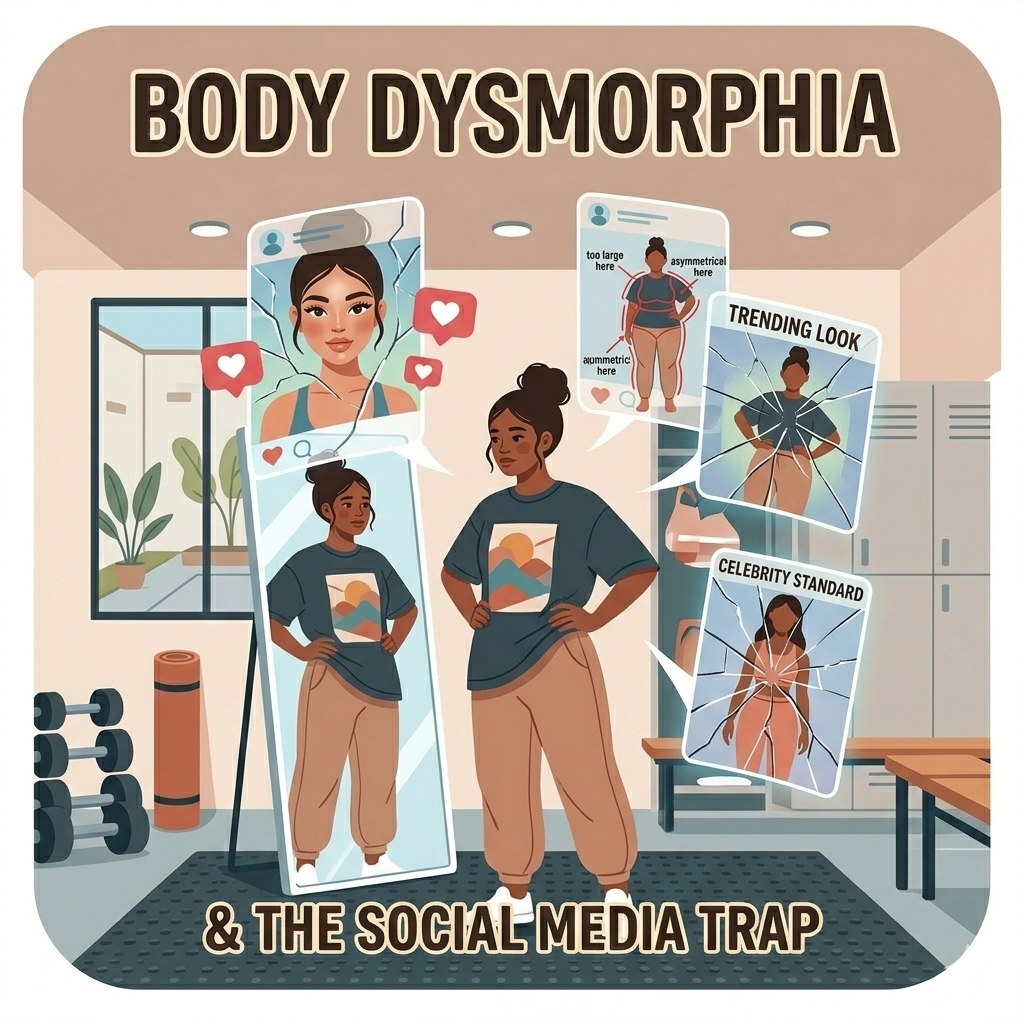
With the growth of social media in the 21st Century, it is inevitable that people will compare their lives to others'. Whether it be the food you eat, the places you travel, or how you look, such constant comparison can result in increased stress and anxiety amongst individuals. Specifically, social media use can damage one's body image, as it provides an unrealistic expectation of what people look like. Influencers are always pushing the new "skinny" diet and "looksmaxxing" technique to garner attention, telling their audience that they too can achieve a "perfect body" by following these rules. In reality, videos and photos on social media are shot with good lighting and angles and edited to achieve an ideal body type. The disconnect between the public's perception of an attainable physique and the reality of one can result in body dysmorphic disorder (BDD) and eating disorders.
BDD is a mental health disorder that is commonly associated with social media. The disorder occurs when an individual becomes hyperfixated on their perceived flaws in their appearance, and will try to do anything to temporarily fix these flaws. Oftentimes, individuals with BDD will have anxiety and avoid seeking social situations that they think will cause people to notice their presumed defects in their appearance. Social media, through its slew of information and images, can fuel insecurities in people that can lead to BDD. Moreover, the public nature of social media can lead to negative comments that can lower self-esteem.
The social pressures to conform to a specific body type can result in eating disorders such as anorexia nervosa and bulimia nervosa. Anorexia nervosa is an eating disorder where people have a fear of gaining weight and measure their self-worth by how skinny they are. People with this disorder often consume very small amounts of food to achieve or maintain their skinny physique. When left untreated, anorexia nervosa can result in malnutrition or even death. Bulimia nervosa is another eating disorder that can result from BDD. People with this condition often binge eat and then try to purge their excess weight through induced vomiting, laxatives, or intense exercise. Additionally, people with bulimia nervosa will associate their binge eating with feelings of shame and guilt, and are critical of their physical appearance. Bulimia nervosa can result in a variety of complications, including heart problems, malnutrition, and gastrointestinal problems resulting from excessive laxative use or vomiting. While BDD and eating disorders share similarities, BDD can occur without the presence of irregular eating patterns, and people with BDD often undergo cosmetic procedures to attempt to fix their appearance. However, BDD and eating disorders can occur comorbidly. A 2011 study conducted by Fenwick and Sullivan found that 60% of people with eating disorders also had BDD.
Social media has magnified the societal pressures that can result in body dysmorphia. But individuals with these conditions can seek help. Cognitive Behavioral Therapy has been shown to fix maladaptive thought patterns in people with BDD and/or eating disorders. Ultimately, however, systemic change has to occur within the realm of social media to see a reduction in body dysmorphia. People have to realize that a lot of what they see online is exaggerated by filters and is not candid, and influencers should utilize their platforms to spread body positivity instead of perpetuating toxic stereotypes of body image.
References
- Fisher, E., Neziroglu, F., & Feusner, J. (n.d.). Eating disorders are not the same as body dysmorphic disorder (and why it matters). International OCD Foundation. https://iocdf.org/expert-opinions/eating-disorders-not-the-same-as-bdd/
- Fontenelle, L., Nascimento, & Prazeres. (2013). Cognitive-behavioral therapy for body dysmorphic disorder: a review of its efficacy. Neuropsychiatric Disease and Treatment, 9, 307. https://doi.org/10.2147/ndt.s41074
- Gupta, M., Jassi, A., & Krebs, G. (2023). The association between social media use and body dysmorphic symptoms in young people. Frontiers in Psychology, 14(1). https://doi.org/10.3389/fpsyg.2023.1231801
- Hasan, M. K. (2025). Meta-stress in the digital age: How social media and constant connectivity create new layers of stress. Annals of Medicine & Surgery. https://doi.org/10.1097/ms9.0000000000003515
- Mayo Clinic. (2024a). Bulimia Nervosa. Mayo Clinic. https://www.mayoclinic.org/diseases-conditions/bulimia/symptoms-causes/syc-20353615
- Mayo Clinic. (2024b, August 9). Anorexia nervosa. Mayo Clinic. https://www.mayoclinic.org/diseases-conditions/anorexia-nervosa/symptoms-causes/syc-20353591
- Murphy, R., Straebler, S., Cooper, Z., & Fairburn, C. G. (2010). Cognitive behavioral therapy for eating disorders. Psychiatric Clinics of North America, 33(3), 611–627. https://doi.org/10.1016/j.psc.2010.04.004